News Story
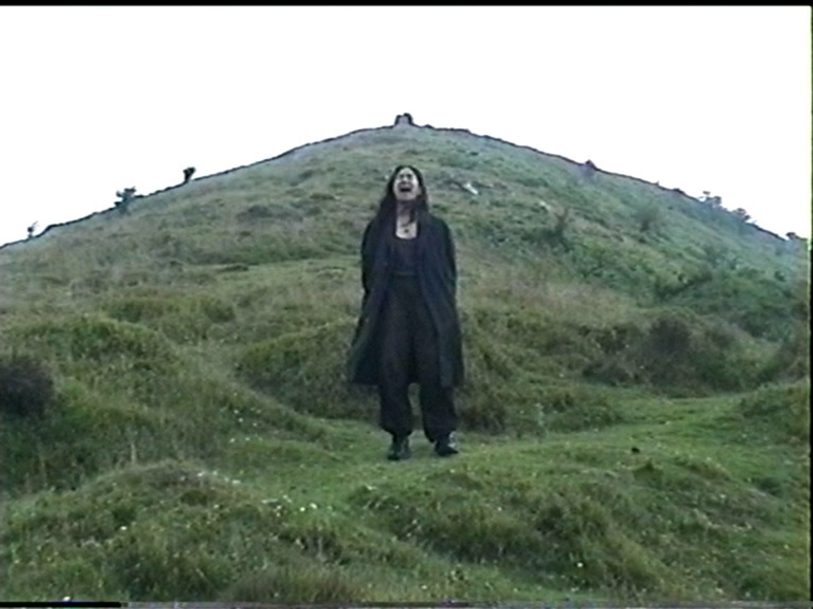
On his lesser-known 1967 visit to Wales, the American beat poet Allen Ginsberg went on a walk in the Black Mountains, took acid at the top of a hill, and wrote a psychedelic poem about the Welsh landscape. Sadia Pineda Hameed’s Wales Visitation – named after the Ginsberg poem – sees the filmmaker follow his original route.
“I've always been interested in where he took the walk but no one's actually mapped it out before, Sadia explains, “So for years and years, I've been trying to figure it out.” She had planned to make a 16mm film about Ginsberg’s walk with a crew and actors, but fate intervened with news that one of the sites he visited, the Capel-y-ffin Monastery, was due to close.
Sadia rang the monastery – which ran a sideline in short-stay accommodation – and was told the last available booking was in two days’ time. “I thought, I have to go now. I didn't have my 16mm camera ready. I didn't have the film. So I just grabbed my Handycam and went and filmed it,” she says.
This now-or-never pressure is reflected in her process. “I'd always imagined shooting the film as the journey, all in one trip, so I ended up kind of unprepared,” says Sadia. Relying instead on intuition, and not entirely sure of Ginsberg’s route but hoping her research was correct, she verifed the way afterwards with maps and accounts of his walk.
In Wales Visitation, Ginsberg's journey starts in London at the famed Dialectics of Liberation congress. For Sadia, the film’s screening at the BFI London Film Festival now echoes the opening of the journey, “So the starting point is the starting point,” she explains. The positioning of the festival appeals to her too, “I'm part of the experimental and artist film programme, but it feels quite interesting to be within the London Film Festival itself because I think my film isn't strictly artist film – it’s part documentary, part drama, part road movie.”
Hi8 video is central to Sadia’s work. “I think people of a certain generation are used to seeing a Handycam – maybe at their birthday party when they were a kid, or using one themselves to film holidays. When you're filming they don't notice you – you can capture some really interesting things and people play to the camera quite easily,” she says.
The medium also lends her practice a certain freedom and intent, “You can be far less precious about the footage because you can just tape over the same tape. I always go back to how precious film feels – you place a lot of importance on all the footage you get, or it can go the other way where we're so used to filming and taking photos on our phones every day that what we’ve captured doesn't feel precious anymore.”
“Using something slightly unusual like a Handycam, you end up just watching for a very, very long time and once you get into that sort of mode then you're surprised with what you're able to capture. It's nice because I can treat anything I do as if I'm filming a home movie for myself.”
Sadia grew up in Kingsbury, Brent and now lives in Wales. She works across sculpture, installation, performance, text, 16mm and Hi8 film and is shortlisted for the 2026 Film London Jarman Award.
This year’s Film London Jarman Award tour sees the best in contemporary artists’ filmmaking at venues across the UK and runs until 21 January 2027.
Wales Visitation screeened as part of the Reconstruction Sites programme at the BFI London Film Festival, Sunday 18 October 2026.