News Story
Plain text version available below
Open an image gallery
RECREATING SHAKESPEAREAN LONDON
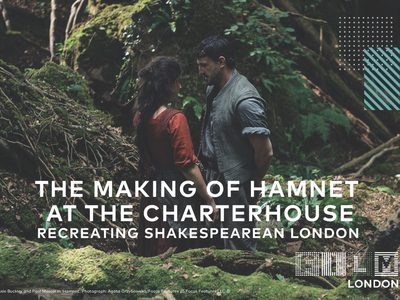
When Hamnet, Chloé Zhao’s lyrical adaptation of Maggie O’Farrell’s novel, came to London, it found a perfect home within the ancient walls of the Charterhouse in Clerkenwell. One of Film London’s Premiere Locations, the site is among London’s most cinematic historic settings. While much of the film was shot in Herefordshire and Wales, the Charterhouse became the beating heart of Shakespeare’s London on screen, hosting nearly all exterior scenes in the Capital. Described by Zhao as a story of grief, love and the healing power of art, the film follows Agnes (Jessie Buckley) and William Shakespeare (Paul Mescal) as they navigate loss and creativity, with the timeless location bringing the Elizabethan period vividly to life.
Film London’s Fernanda Franco spoke with Supervising Location Manager Lindsey Powell and The Charterhouse’s Head of Venue Hire, Miko Małkowski, about how the site’s historic architecture, versatile spaces, and experienced team made it ideal for a large-scale period production. They shared insights on transforming a 600-year-old heritage site into plague-era London, managing night shoots alongside live events in a working space, and why authentic locations like The Charterhouse continue to make London a world-class destination for filmmakers — now more than ever in an age of CGI and AI.
Miko, how long did Hamnet film at The Charterhouse?
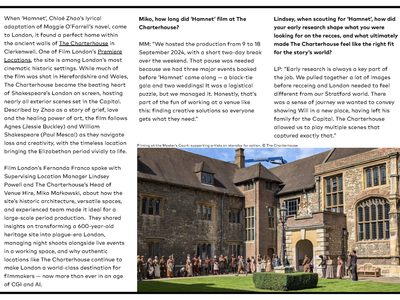
MM: “We hosted the production from 9 to 18 September 2024, with a short two-day break over the weekend. That pause was needed because we had three major events booked before Hamnet came along — a black-tie gala and two weddings! It was a logistical puzzle, but we managed it. Honestly, that’s part of the fun of working at a venue like this: finding creative solutions so everyone gets what they need.”
Lindsey, when scouting for Hamnet, how did your early research shape what you were looking for on the recces, and what ultimately made The Charterhouse feel like the right fit for the story’s world?
LP: “Early research is always a key part of the job. We pulled together a lot of images before recceing and London needed to feel different from our Stratford world. There was a sense of journey we wanted to convey showing Will in a new place, having left his family for the Capital. The Charterhouse allowed us to play multiple scenes that captured exactly that.”
What makes The Charterhouse ideal for filming a period piece like this and how do you manage productions of this scale?
MM: “The Charterhouse is a dream for period dramas — 600 years of history across seven acres, with layers of medieval, Tudor, and Jacobean architecture. Many spaces need minimal dressing to feel like authentic London or even Oxford or Cambridge. My approach has always been to make The Charterhouse as film-friendly as possible. With a creative background, I understand both the beauty and the challenges of production. Over the years, working on major projects like The Crown and Downton Abbey helped us develop an operational blueprint that makes hosting large-scale shoots safe, efficient, and collaborative.”
LP: “The Charterhouse offers both interior and exterior filming options and allows a setting unlike many others in London. Multiple period squares of different sizes are fully controllable and the team is committed to supporting filming. With original features aplenty and the ability to service your shoot close by with support from neighbouring City of London and Islington filming teams.”
How much set dressing took place? Did The Charterhouse look very different?
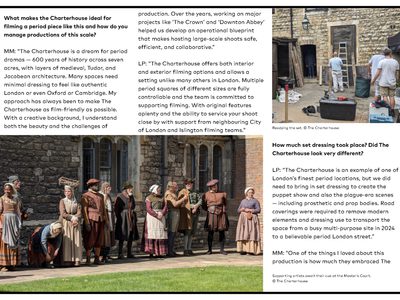
LP: “The Charterhouse is an example of one of London’s finest period locations, but we did need to bring in set dressing to create the puppet show and also the plague-era scenes — including prosthetic and prop bodies. Road coverings were required to remove modern elements and dressing used to transport the space from a busy multi-purpose site in 2024 to a believable period London street.”
MM: “One of the things I loved about this production is how much they embraced The Charterhouse’s authentic character. Director Chloé Zhao has a real eye for atmosphere, and she fell in love with Washhouse Court and even our young magnolia tree there, both of which feature beautifully in the film. Other than covering modern fixtures and adding props, the spaces are very recognisable. The street scenes used a bit of green screen for London extensions, but if you know the site, you’ll see the real Charterhouse shining through.”
Were any particularly notable scenes filmed at The Charterhouse that audiences might recognise?
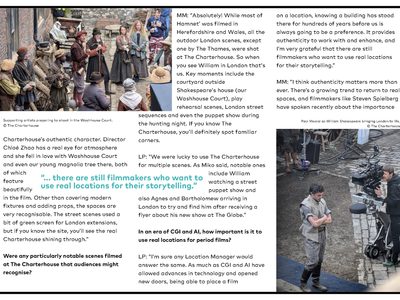
MM: “Absolutely! While most of Hamnet was filmed in Herefordshire and Wales, all the outdoor London scenes, except one by The Thames, were shot at The Charterhouse. So when you see William in London, that’s us. Key moments include the courtyard outside Shakespeare’s house (our Washhouse Court), play rehearsal scenes, London street sequences and even the puppet show during the hunting night. If you know The Charterhouse, you’ll definitely spot familiar corners.”
LP: “We were lucky to use The Charterhouse for multiple scenes. As Miko said, notable ones include Will watching a street puppet show and also Agnes and Bartholomew arriving in London to try and find him after receiving a flyer about his new show at The Globe.”
In an era of CGI and AI, how important is it to use real locations for period films?
LP: “I’m sure any Location Manager would answer the same. As much as CGI and AI have allowed advances in technology and opened new doors, being able to place a film on a location, knowing a building has stood there for hundreds of years before us is always going to be a preference. It provides authenticity to work with and enhance, and I’m very grateful that there are still filmmakers who want to use real locations for their storytelling.”
MM: “I think authenticity matters more than ever. There’s a growing trend to return to real spaces, and filmmakers like Steven Spielberg have spoken recently about the importance of craftsmanship in cinema while promoting Hamnet. Productions like this one remind us why. It can be more challenging to work in a Grade I listed site, but the results are breathtaking. When you see the film, you’ll understand why it was worth it.”
How would you describe the overall filming experience? Any challenges or favourite memories?
MM: “So many! First, a huge shout-out to Lindsey Powell, the Supervising Location Manager, and the whole team — Yago, Paula, Meg, Charlotte. We worked as one unit, which made everything enjoyable despite the complexity. Highlights? Late-night recces, bringing in the biggest lighting crane we’ve ever had and hosting the most 'plague victims' (fake corpses!) I’ve ever seen on site. The biggest challenge was juggling filming with that gala and two weddings. One wedding couple even had to walk through part of the set filled with fake bodies to reach the gardens for photos. We warned them, of course, but they loved it and said it was a highlight of their day!”
LP: “We had an incredibly positive experience at The Charterhouse. Miko and his dedicated team attended every recce with us, accommodating out of hours requests as we planned night shoots and working with us on all our intentions. The Charterhouse is not only an events venue but also a residential site, so we needed to ensure that communication with all residents and staff was key before filming at night. For the night scenes, we needed to light Washhouse Court. There are always challenges when working with modern equipment versus small-scale access of period properties, but after discussions, site visits and structural checks, Miko was able to allow us to use an entrance not regularly permitted. This enabled the required lighting effects without compromising the building’s safety. The puppet show was a personal highlight for me. I won’t go into detail to avoid spoilers, for anyone who has not seen the film yet.”
Is The Charterhouse keen to host more productions of this scale? Any exciting projects since Hamnet?
MM: "Absolutely! The Charterhouse loves hosting big productions and it’s a relationship I hope will continue. Since Hamnet, we’ve welcomed projects like My Oxford Year, The Runner, The Gentlemen 2, and a few others under NDA. We also filmed The Bitter Endwith Joan Collins and Isabella Rossellini, brought in by Simon Scott — one of my favourite location scouts. We’ve also been very popular recently for support location and unit base enquiries for productions around Barbican and Clerkenwell. The Charterhouse can host costume, hair and makeup units, catering, technical parking, unit base operations, or crowd holding for 300+ people."
What’s been your favourite filming experience at The Charterhouse?
MM: “Tough question! Three stand-outs: Pennyworth, brought in by EJ Richards - our first big production here and a real game-changer. The Crown, an absolute joy to work on with Chris Johnson and his team – we made some history here! And of course, Hamnet. But honestly, what excites me most now is what’s next. There’s so much opportunity for sites across London to become confident, creative and profitable in this space.
Hamnet premiered in Europe as the Mayor’s Gala at the 2025 BFI London Film Festival, with stars and producers including Steven Spielberg and Sam Mendes in attendance and went on to win the Audience Award for Best Feature. More recently, Jessie Buckley won Best Actress at the 2026 Critics’ Choice Awards, cementing the film as one of the season’s standout productions.
Released in UK cinemas today, the film offers a fresh reimagining of Shakespeare’s world and a rare chance to see The Charterhouse brought vividly to life as Elizabethan London.
You can find further details about filming at The Charterhouse here.
Watch the trailer for Hamnethere.