News Story
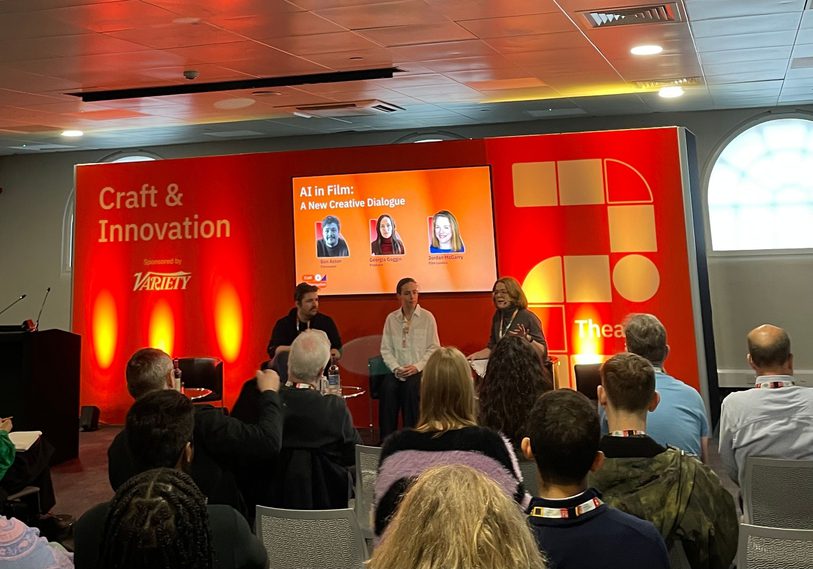
Film London had a full slate at this year’s FOCUS, the London-based trade event bringing together reps from film, TV, advertising, animation and games.
Jordan McGarry, Film London’s Head of Talent Development & Production, led the event’s opening session: AI in film: a new creative dialogue. The room was jam-packed for the eye-opening discussion, which shared insights from a pilot scheme that examined how AI might assist teams of UK and Lebanese creatives at different stages of the filmmaking process.
Alongside Jordan were BIFA-nominated writer, director and producer Georgia Goggin (Pretty Red Dress, We Love Moses) who scripted one of the scheme’s short films, and Screen Star of Tomorrow Ben Aston (He Took His Skin Off For Me, Russian Roulette), a filmmaker whose own AI explorations helped inform the initiative.
The discussion was frank and lively, with Jordan explaining from the outset that one of its aims was to help wrest the narrative back from tech leaders and put it in the hands of the creative community.
“I came from a place of being terrified and ignorant but wanting to be terrified and informed,” said Georgia. While she drew a hard line at allowing AI to write her script, Georgia tested ChatGPT’s facilities as a development exec. The results were mixed at best, with its script notes seeming informed and au fait with industry lingo only to be debunked upon further interrogation. “It would always rather affirm what I was trying to do rather than provide an uncomfortable truth,” explained Georgia. “I was feeling positive about an early draft thanks to the initial ChatGPT feedback, but our human producer took one look at my script and pointed out that there was zero conflict.”
Elsewhere, Georgia encountered issues when it came to authentic Lebanese dialogue, names and geography, which, combined with the amount of time spent prompting, did not leave a positive lasting impression. “It would constantly offer me something untrue in place of facts because it’s designed to please,” she said. “That shredded my faith in the platform.”
Like Georgia, Ben had decided to tackle AI head-on due to his own lack of knowledge. “About a year and a half ago I was freaking out about AI,” he admitted. “It occurred to me that there was a huge gulf in terms of knowledge, and that this left things wide open for hucksters to exploit.” Rather than a creative force, Ben likened AI to a highly knowledgeable but ultimately boring friend, suggesting that the most interesting experiments with AI tended to take the form of “nightmare scat jazz” visions.
Ben suggested that visual fidelity was clearly becoming less and less of an issue for the technology and that there were possible use cases when it came to rotoscoping, compositing and pick-ups, but that the human drive to create art and tell stories was still absolutely key. What this did mean, however, was that filmmakers should be mindful as to how much the tech might corrode their process or filmmaking fingerprint.
Georgia, whose main positive takeaways stemmed from working with her fellow (human) filmmakers, agreed wholeheartedly. “It sometimes seems like the end goal of all this is to allow someone to make a film on their own,” she said. “For me, that’s like saying the solution to climbing Mount Everest is to bulldoze Mount Everest.”
AI In Film: A New Creative Dialogue is a project created by Fondation Liban Cinema in collaboration with Film London, with the support of the British Council International Collaboration Grant. The two new short films will screen as part of the London Short Film Festival in 2026, and a report on the pilot scheme’s findings will be produced in the new year.