Dylan Huw
Sadia Pineda Hameed believes, I suspect, in the world-shifting capacity of a good love song. Her film The Song of My Life (2020) introduced me to the Filipino ballads of Nora Aunor, whose song of that title serves as a musical skeleton-key to unlock Sadia’s remixed family narrative. The love song is a medium defined by its utmost sincerity, rendering gendered and culturally encoded orthodoxies of politesse, intellect and reason secondary to pure feeling. Every good love song is a political argument in favour of sensation itself, for the enormity of the idea that nothing makes the world go round like the indescribable power and extra-linguistic strangeness of feeling feelings — even as we know, instinctively, that all these feelings have been felt before.
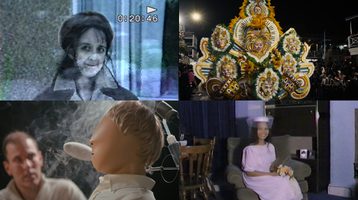
Might the same be said of the medium of artists’ film? That the reason we look to this field of practice, one so restlessly resistant to definition, is to forge understandings of expressions and environments that come from someplace more intuitive — more lived — than can be contained by conventional narrative or language? In recent years, Sadia has advanced a distinctive authorial style from playfully collaged public archives and analogue film, which connect embodied personal-political passions to existing image-histories. These films are animated, often, by a commitment to tracing the afterlives of communal struggles, particularly in the Philippines and Wales, and several — Agimat (2025), Moving Sound (2025), Anak Where Did We Stay? (2026) — have been occasioned by invitations to respond to sited media histories. But their pleasures are of an energisingly free-associative sort. Sadia’s is a first-person cinema dictated by rhyme and rhythm, a filmic grammar which makes room for tactility and handheld-ness, humour and personality, privileging small gestures and minor histories over any pretence of grand statements of recovery or reclamation.

Sadia Pineda Hameed, Moving Sound (2025), film still
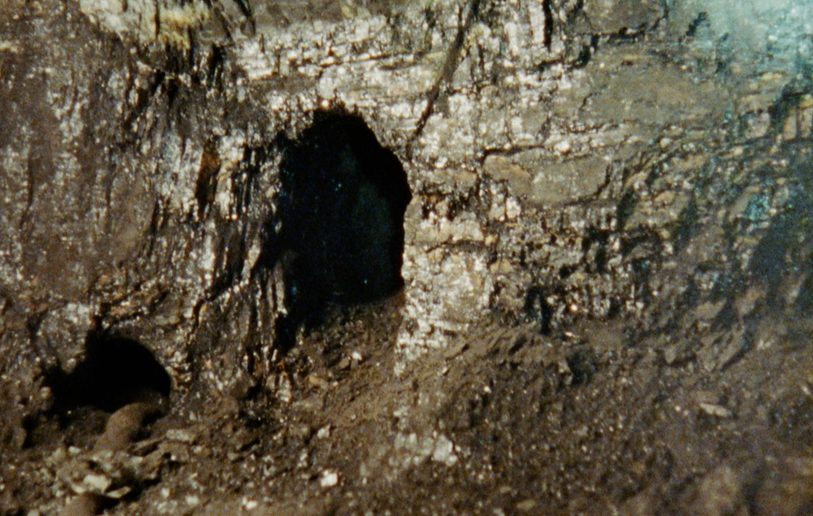
Montaging public and personal archives for poetic and indirectly ‘political’ effect is such a dominant mode in contemporary artists’ film that I sometimes wonder whether it still has the capacity to surprise or challenge. But Sadia’s recent experiments — as musical in form as they are conventionally narrative or essayistic — attest to new liberations still to be mined from the field’s archival turn. These films are grounded in a deep sensitivity to, and curiosity about, place and places, and an exuberant fascination with human storytelling; they are never opaque for opacity’s sake. They also demonstrate an attunement to dynamic tensions between their images’ prehistories and the material conditions of their re-presentation. Consider the setting in which Moving Sound was first shown: among the disused machinery of the Big Pit in Torfaen, a former coal mine turned museum that preserves south Wales’ industrial heritage while promoting an institutionally sanctioned history. This environment of largely obsolete, utilitarian craft and industry proved a generative one for a film whose audiovisual DNA is defined by the tactility of appropriated documentary images not necessarily designed for public view.
The film brings together the artist’s 16mm footage of an underground mine with a speculative narrative voiced by the artist’s mother, which imagines a transhistorical audio transmission from contemporary protest sites to striking workers in the 1980s. The voiceover, which Sadia has sometimes referred to as a “radio play”, forges resonances between land-embedded workers’ resistance movements across eras and geographies. Seizing on the recognition that stories of mining strikes and other forms of labour resistance are best documented not by formal archives but by the oral testimony of workers, the film privileges the sonic collage as a device for a time-travelling kind of network-building, not bound by linear logics. “They are stopping trucks in Jujuy, marching in Kinshasa, forming barricades in Palawan,” the narrator states; and still, they “build mutual aid kitchens, light vigils in cities, sing in their own tongues.”
The film wears its research lightly, serving an almost fablelike ode to the continuously reproductive forms of collective resistance to oppressive labour structures. Sadia is proudly anti-nostalgic in her intertwining of non-linear chronologies — “Do you also feel time and distance collapsing?” our narrator asks, her address ambiguous. Emotive yet knowingly withholding, Moving Sound continually destabilises the viewer from any fixed perspective or origin. Gradually we notice images of what look to be present-day workshops and protests. From the credits we learn that this is archival footage from the ecological sound collective Soundcamp, whose DIY audio devices inspired the film’s premise. We also discover that the voiceover text is an amalgam, freely quoting particularly from the Filipino artist-activist David Medalla’s ‘MMMMMMM…Manifesto (a fragment)’ (1965). Medalla’s text is built of responses to a self-posed question: “What do you dream of?”, answered by prose-poetic shards that imagine impossible sculptures roaming the earth. Moving Sound climaxes in what we might receive as a revision of that question, posed sixty years later: “What remains?” This revision gets to the documentary crux of Sadia’s project: where Medalla’s dreams are an unending future expanse, hers bear the weight of all the politicised pasts to which our generation have immediate, if highly mediated, access.
Sadia Pineda Hameed, Moving Sound (2025), film still
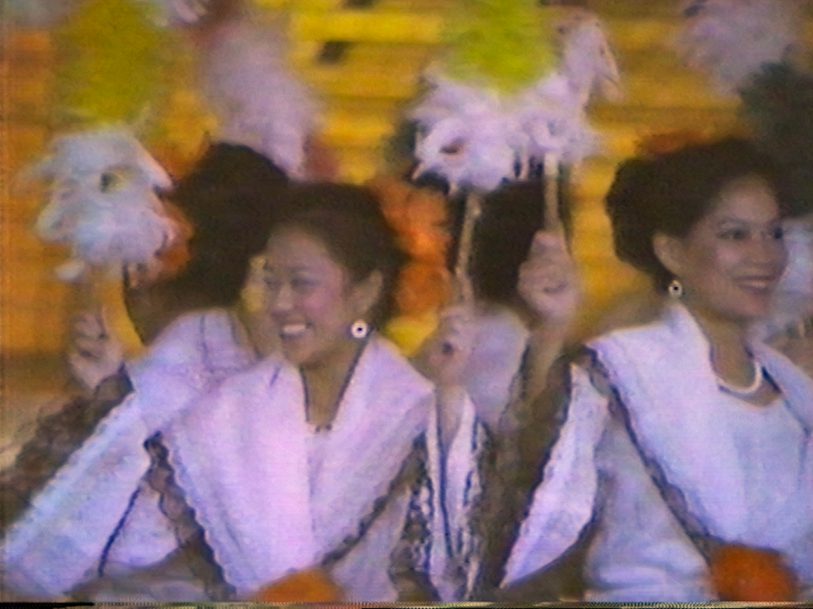
The voice of Sadia’s mother, Luisa, has been a recurring protagonist dating back to tiny bubbles in the wine (2019), and intergenerational collaboration works continuously to root her extensive site-responsive artistic research in embodied, up-close history. Anak Where Did We Stay? unfolds as a sequence of criss-crossing dialogues. A wide-ranging span of personal and appropriated home movies is overlaid with audio of intimate conversation between Sadia and Luisa, which acts as a kind of commentary to the footage. Often punctuated by laughter, their voices informally track a multi-generational arc of travel and migration. The film draws much of its material from the home-movie collection of The Box in Plymouth, where it was originally staged as a five-channel installation. The sensory abundances of the multi-channel format offer rich avenues for Sadia’s distinctly fabulist form of public-private media excavation in the interplay of images and sounds. Here the musical quality of Sadia’s mode of montage is at its most potent, as is her incorporation of love songs, its images of blossoming romance accompanied by ‘The Hawaiian Wedding Song’: I do (I do) love you (love you) with all my heart. The soundtrack’s swells of elemental emotionality coat the images in a subtle melancholy, suggesting a bittersweetness to the passing of time and the changing of climates between one image and the next.
Sadia Pineda Hameed, Anak Where Did We Stay? (2026), film still
The multi-channel expansiveness of Anak marks a significant development in Sadia’s practice, but her hallmark looseness and spontaneity of inspiration is still on full display. The moving image is one of many tools in her arsenal, and the films emerge into public view in relation to texts, environmental interventions, live performances, and objects. This material continuum is one of the key attributes of her practice. In the artistic ecosystem in Wales, in which she has been immersed for almost her entire adult life, she is equally well-known for her films as for her commitment to enabling other artists and writers to make similarly playful and speculative work. With each project, she both advances and refines the scope of her endlessly curious and anti-disciplinary practice as one continuous process. For all their embrace of the contingency and slipperiness of personal and mediated memory, her films and installations frequently return to the notion that some things — like love, like memories held in landscapes — are fixed. Some things do remain.
Dylan Huw is a writer and artist living in Caernarfon, Cymru/Wales. With the sculptor Manon Awst, Dylan is representing Wales at the 61st Venice Biennale with Sownd, a multi-platform excavation of site-specific echoes and inheritances. In 2025, he established Testun testun, a curatorial project dedicated to expanded art/writing practices in Wales. His first book of non-fiction, a three-part essay on criticism, friendship, and “the shape of the present,” is forthcoming from Cyhoeddiadau’r Stamp.