Abiba Coulibaly
Taking its name from a diminutive Guyanese songbird with a bright yellow underbelly and flame-like wings, the Keskidee Centre was Britain’s first arts centre for its Black community. Opening in 1971 in Islington, it provided infrastructure for the political and cultural activity of the Windrush generation and their children. Its founding coincided with the Immigration Act 1971, a bill that would effectively bring the era of Windrush migration to an end. Early on in her most recent film, Okay Keskidee! Let Me See Inside, Storr states a geography: ‘Black Britain’, consolidated and material, rather than the more habitual ‘Black British’, an abstract and unsettled demonym. Across her filmography, she maps this territory’s contours, faultlines, and hubs.
Okay Keskidee! Let Me See Inside turns inward from the exteriority of Storr’s wider body of work, which tends to roam green and public spaces across the breadth of the country. She has often observed the socio-spatial choreography produced by carnivals, in which masses settle into the roles of performer and spectator, participant and onlooker, in quintessential arenas of British civic space such as high streets and parks. “Let me see inside” could be read as a plea, or a demand, willing an exploration of the insular spaces — and the cumulative labour and kinship they enable — that sustain the more public spectacles found throughout her work. The film moves between four sites central to the social, political and cultural life of London’s Caribbean community: the West Indian Cultural Centre, the George Padmore Institute, the former West Indian Students’ Centre, and the now-defunct Keskidee Centre. Throughout, we read Storr’s internal monologue rather than hear her voice, placing us not in the position of being told about each building, but rather accompanying her in the uncertain process of how, and whether, she might encounter it.
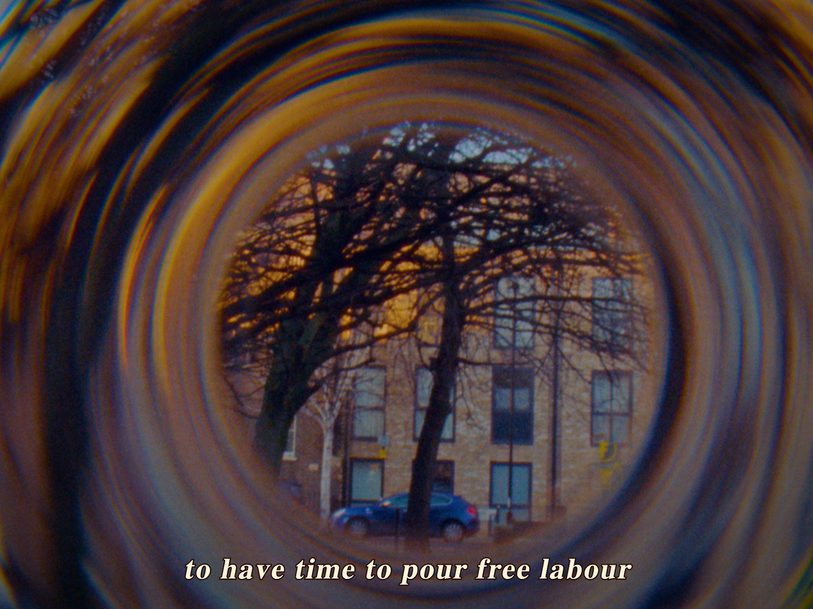
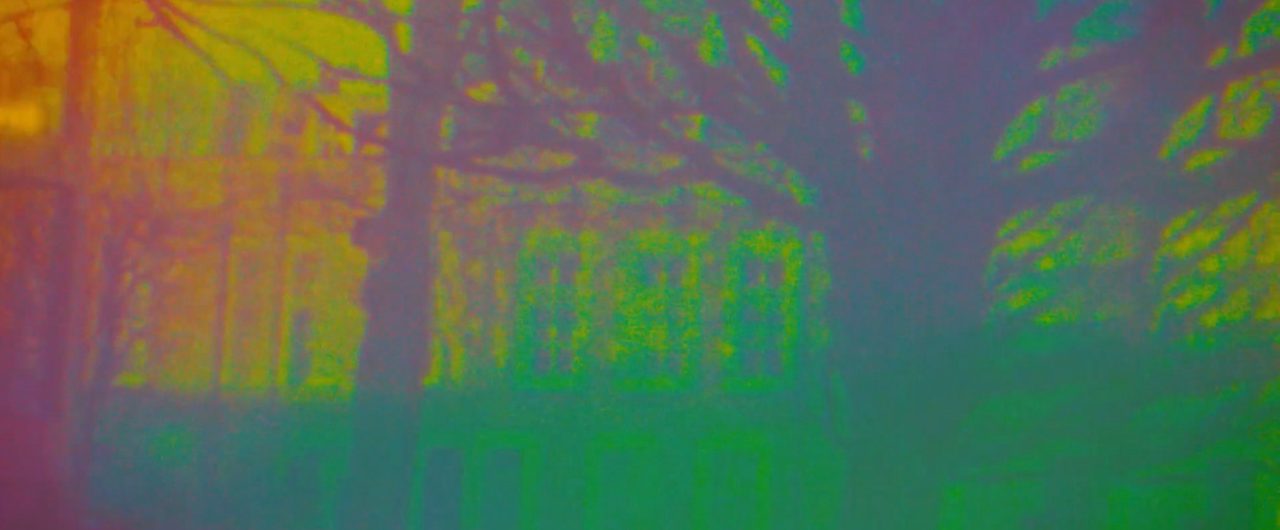
Rhea Storr, Okay Keskidee! Let Me See Inside (2025), film still.
Storr’s film is one of unfulfilled anticipation, of being kept at bay. Access is denied at the West Indian Cultural Centre, and we do not see inside the titular Keskidee Centre. We cannot see inside; the centre closed in 1992, reopening as a church before its site inexplicably burned down in 2012. Even retrospective access is fraught, denied or mediated by profit. We are told that some archival materials are “too expensive to show you here”, with some images costing £350, while others are impossible to license due to the obscurity of their ownership, caught in an archival proprietary limbo. Of these spaces, Storr knows their worth is “more valuable than gold”: priceless, even if the images that capture them can be assigned a prohibitive monetary value.
Earlier films do allow us to see inside. Though set in Ladbroke Grove, scenes from Horace Ové’s seminal Pressure (1976) were filmed in the centre. As was Bob Marley’s music video for Is This Love? in which Keskidee is transformed into a backdrop for a dreamlike children’s disco starring a seven-year-old Naomi Campbell, one of many in the centre’s formidable roster of visitors: Steel Pulse, Walter Rodney, Kamau Brathwaite, Derek Walcott, and Angela Davis.
We also enter the centre in Franco Rosso’s 1979 portrait of dub poetry innovator Linton Kwesi Johnson, Dread Beat an’ Blood. Johnson was a librarian there, and we hear him identify with the unemployed and overly-surveilled youth who frequent Keskidee, after recounting his own experiences of being unable to find work. Like Storr’s film, Dread Beat an’ Blood traces itineraries of diasporic organising through transit hubs and subterranean journeys across the city, with Johnson portrayed descending into the cavernous Brixton underground to board the Victoria line, where he settles into the dislocated suspension between stops. This errant and connective behaviour is also present in the manipulation of the archival photographs of the Keskidee Centre that appear in Storr’s film. Using a rostrum camera and digital manipulation, she drags our gaze across zoomed-in fragments of each photo, allowing us to observe snippets and individual faces but never the entirety of the scene at once. Instead, we become conscious of the tactile choreography and labour of operating the analogue equipment central to her practice.
Through both what Storr is granted access to and what she chooses to show us, the archives offer fragments rather than a whole. Though the images are evidence of what was forged at the centre, this fragmented perspective reminds me of the dispersal and enforced estrangement that occurs when physical space is lost.
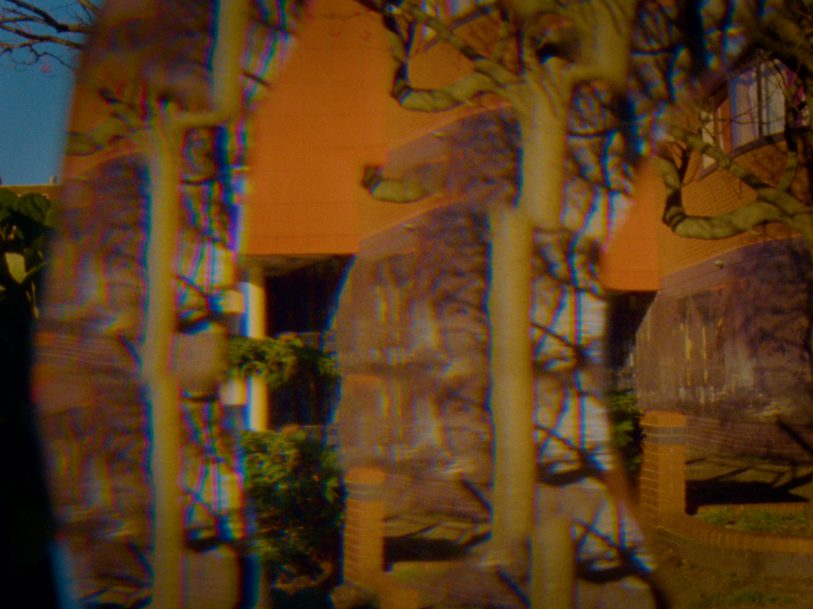
Rhea Storr, Okay Keskidee! Let Me See Inside (2025), film still.
In the film, Storr asks: “How does Black youth understand if the space is erased or trapped in the archive?” I fear that this, and the many other questions the film raises about access, infrastructure, and the ability to develop and consolidate artistic practices and political movements, are ones with answers I might rather not acknowledge. Keskidee’s fate is not the only kind Storr encounters or puts forth. Her wider filmography is testament to communal spaces that continue to persist: the Heritage Centre in Wolverhampton and SADACCA in Sheffield, both featured in Subjects of State, Labours of Love (2025), or the Burton Caribbean Association in Staffordshire and Edmonton’s Green Towers Community Centre, documented in her unreleased film Freedom Dreaming. Nevertheless, Keskidee’s fate is not an isolated loss. It is indicative of a wider dual pattern of commodification and dispossession of space and cultural heritage, to which there is no easy solution. Attempting to piece past sites back together on film can only do so much. Storr is aware of the limits of her medium, stating, “no journey I make could replicate the community”. She hints at alternatives in the present world, alluding, somewhat ambivalently, to digital spaces for gathering as we lose physical ones.
The archive can preserve (and monetise) their images, but not the conditions that produced them; the film can retrace their routes, but cannot return us to where they led. This is perhaps the most painful part about watching Okay Keskidee! Let Me See Inside. It does not mistake piecing together and retracing the archives for a revival. There is no neat resolution waiting at the end of the journey. The centre is gone, and the spaces that might stand in for what it offered are being made increasingly unviable, evidenced by the closure and proposed sale of the Africa Centre as I write this. When the ominous harbinger of a green and yellow Foxtons sign appears at the site of the Keskidee Centre, now under development for luxury apartments, the film’s accumulated fragments suddenly make way for something brutally legible: the kind of space Storr acknowledged as “more valuable than gold” has acquired another value entirely, one that is quantifiable and immeasurably disruptive. Storr and her patient investigating cannot undo that loss. She can only make us look at it.
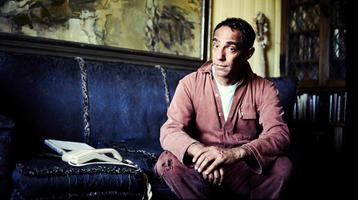
Abiba Coulibaly is a film curator with a background in critical geography. She is the founder of Brixton Community Cinema and Atlas Cinema, two experiments in democratising access to cinema as both a space and medium.