Oliver Basciano
Ilona Sagar deconstructs the documentary format out of necessity. By rebuilding the medium as a kaleidoscopic, fractured, artwork, often spread across multiple screens, she has sought the most adept way to tell stories of illness and treatment from all the fronts she’s seeking: medically, emotionally, politically, architecturally.
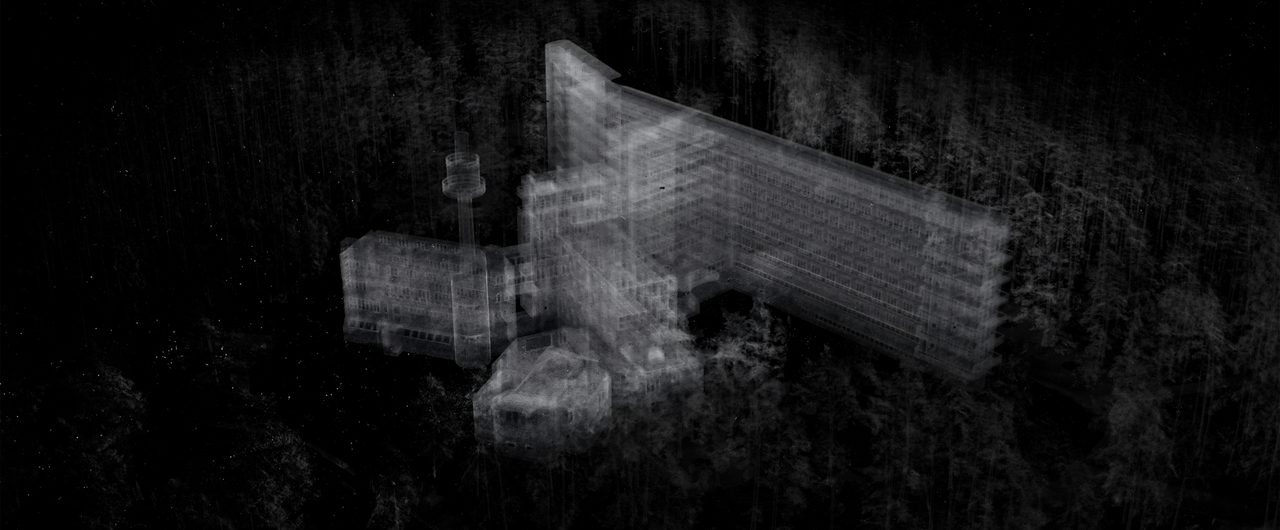
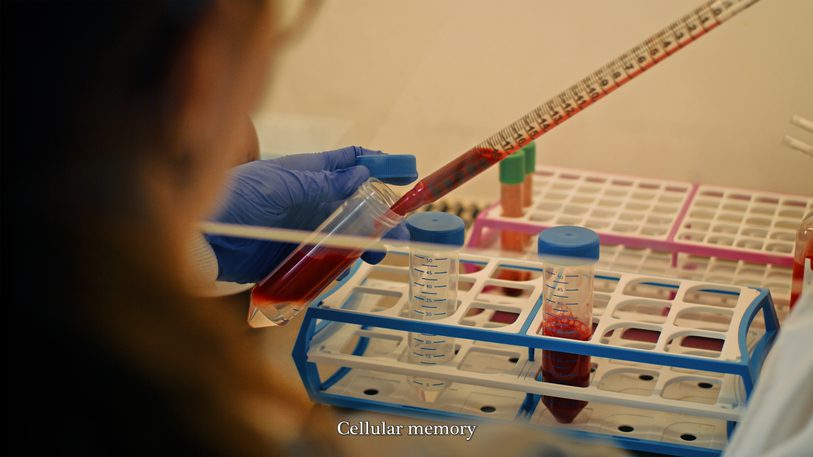
Other Actors (2025) is a portrait of Paimio Sanatorium in Finland, designed by Alvar and Aino Aalto for the treatment of tuberculosis patients. Completed in 1933, the modernist building later became a general hospital in the 1960s, and finally a respite centre for children with learning differences. Sagar made her film when the site was empty and at risk of dereliction, its future unknown and precarious. Its story, more restless than the bald facts above suggest, is told from the perspectives of the mothballed hospital’s former staff and its ex-patients; the late architects and their families and former colleagues; from scientists and historians. The artist invites perspectives to collide and collage, “assembling layers of professional and lived experience”,1 opening gaps in the narrative as these histories weave and fold into each other. The story draws from the memory of the mycobacteria itself; from the memory of the architecture; from the arboreal memory of the pine trees that surround the white-rendered building, mere saplings at its inauguration.
Ilona Sagar, Other Actors (2025), film still.
Sagar’s work resonates with what Hal Foster has called the ‘archival impulse’, the bringing together of disparate artefacts and narratives “through mutations of connection and disconnection”.2 An opening scene sees the building’s long-term caretaker, who has ushered the architecture through its various permutations, sifting through a drawer of bolts, hinges, bits and bobs. “When you work with these things every day, it’s like an archive,”3 he says matter-of-factly. Yet there is no nostalgia on Sagar’s part, no romanticism for a decayed modernist past. Instead, these material traces, and the amorphous recollections of the building’s inhabitants, act as an alternative archive to the medical records and state censuses that would otherwise document the life of Paimio. In Other Actors, tuberculosis is not a disease that divides the sick and the well, the passive patient and the expert doctor, but a horizontal organising device, a biological space in which stories of othering, from immigration to economic obsolescence, shift around.
Paimio Sanatorium was likewise designed not as “a fixed object but a process”, a place focused on the spatial needs of “the horizontal” patient.4 Just as the bacteria had found refuge in the body, so the body found a place of safety in Paimio. “Tuberculosis occurred for the first time when we went inside… architecture creates disease… the paradox is that architecture always presents itself as offering health,” Sagar’s narrator says.5 A cleaner points out that if one is climbing the various stairs of the seven-storey building — each step likely accompanied by a heavy breath for the recuperating resident — at no point is one facing a blank wall, but floor-to-ceiling windows. “Somehow it gives you a grand feeling every time,” she explains as she methodically mops each yellow-painted step.6 Aino designed the undulations of the Paimio chair to stretch out the diaphragm. Alvar created the collegiate balconies, on which patients would rest and gather, seeking a sense of community. As the idea of “health citizenship” developed in the wider world — that one’s segregation was an obligation an individual holds to society — so too did a sense that at the sanatorium you might find solidarity amongst the community of the sick.
Ilona Sagar, Other Actors (2025), film still.
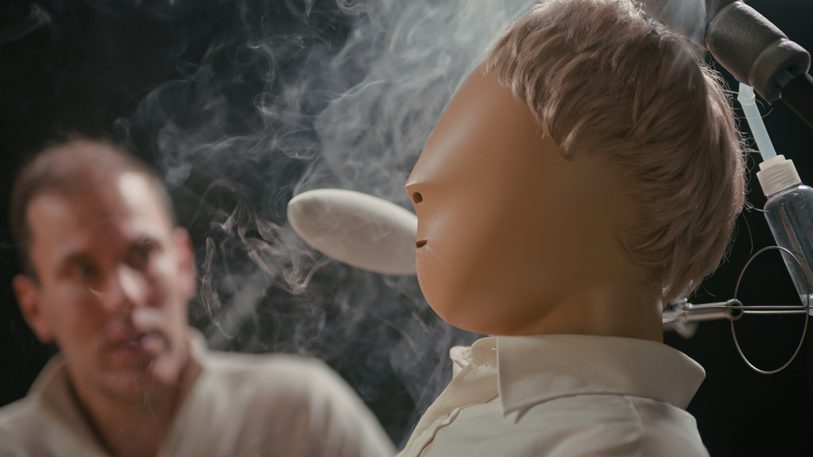
At the beginning of the twentieth century, tuberculosis was the most common recorded cause of death in Finland, reflective of its prevalence throughout Europe. Its active bacteria, borne by breath, attacked the lungs, the bones, and the nervous system of the patient. While a major breakthrough in treatment came in 1943, for decades before (and still for many years after), clean air and sunlight, rest and therapeutic exercise, were often deemed the best remedy. Governments across the continent — though particularly in the Soviet Union and Nordic regions — built sanatoria on a mass scale, opening these residential hospitals up to a public far beyond the privileged characters of Thomas Mann or Edvard Munch that had once been their mainstay patrons. Ensconced in islands of ill health, patients might stay for years in recuperation: even after the medical advances came, medication would need to be taken for a minimum of six months, often much longer, and always administered under the direct observation of a doctor.
The Aaltos were designing for the weakest members of society; the world outside, however, remained dedicated to the strongest. To be ‘modern’ was to be economically useful and productive, the biopolitical imperative that underlies the neoliberal state: Aalto’s modernism was in service of getting people better, in building a forward-looking society within the newly independent Finland. It is a testament to what Donna Haraway credited as the “the power of biomedical language — with its stunning artefacts, images, architectures, social forms, and technologies — for shaping the unequal experience of sickness and death for millions.”7 Sagar has form in identifying the tangled webs of capital, health and the built environment. Her 2022 film The Body Blow was developed through longterm collaboration with those affected by asbestos cancers, a sickness that not only lies within buildings, but is also interwoven in the bureaucracy of the state. “What is a good body?” asked the 2018 film Correspondence O, a portrait of the Pioneer Health Centre in Peckham, meditating on the idea of ‘body capital’ and the value of health to the individual, to the social contract, and to the bottom line of the extractivist classes.
Ilona Sagar, Other Actors (2025), film still.
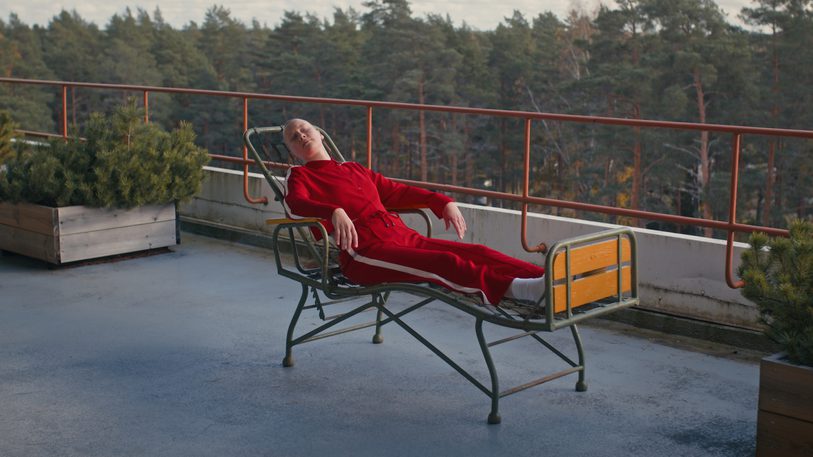
Interweaving Sagar’s interviews in Other Actors is an hour-long continuous soundtrack (composed by long-time collaborator Seth Scott) featuring wind instruments and vocals, a nod to the asymmetrical rhythms of interrupted breath. The film’s first-person narration might initially be understood as voicing the thoughts of the androgynous figure in a red tracksuit whom the artist films pacing the empty hospital. Yet, just as oxygen is a shared resource, it becomes clear that the thoughts are also pluralistic and interconnected. Established as unsteady and ambiguous, the narrator increasingly crashes biomedical boundaries, animates the architecture and editorialises the strands of necropolitical histories that Sagar teases out, blurring the distinctions between person- and object-hood. “You drew me, formed me, shaping a pitch into flesh,” the voiceover softly intones at one point.8
Sagar faces up to the contemporary experience of tuberculosis through the work of the Kalasatama Undocumented Migrants Clinic. A historian points to the assimilating impetus of the Nordic welfare state, and the limits of its much-vaunted mantra of tolerance.9 Against the ideal of the ‘good’ immigrant, one whose ‘healthy’ body is given in the service of capital, there is the spectre of the sick incomer, a body that ‘weakens’ the host nation. Contravening this binary, Sagar presents possible new forms of citizenship and inclusiveness away from the eugenicist impulses of nationalism and neoliberalism, a biocitizenship embodied by the queer figure Sagar films throughout the empty building. This new body, suggested by the utopian ideals of the building and by Sagar’s spatial rendering of history, is one that operates beyond the traditional forces of control and commodification. Inside the sanatoria bodies were granted rest, flesh was encouraged to stretch out, muscles were allowed to relax; outside the building, they remained human resources. Other Actors is a film that proves variously mournful, elegiac, powerful and campaigning: a testament to how history is embodied by biology, people and environment.
1 Ilona Sagar in conversation with Silvia Casini, ‘After images: technologies of the body and the archive,’ in F. Johnstone, A. Morehead, & I. Wiltshire (eds.), Art and the Critical Medical Humanities (London: Bloomsbury Academic, 2026), p.40.
2 Hal Foster, ‘An Archival Impulse,’ October, (110, Fall 2004), pp. 3–22.
3 Jukka Erinko, retired maintenance worker, Paimio Sanatorium, in Ilona Sagar, Other Actors (2025).
4 Sagar, Other Actors.
5 Beatriz Colomina, architectural historian, in Sagar, Other Actors.
6 Eeva Tuulevi, cleaner, Paimio Sanatorium, in Sagar, Other Actors.
7 Donna Haraway, ‘The Biopolitics of Postmodern Bodies: Determinations of Self in Immune System Discourse’, Differences, 1:1, (1989), pp.3–4.
8 Sagar, Other Actors.
9 Peter Stadius, professor in Nordic Studies, in Sagar, Other Actors.
Oliver Basciano is a journalist and critic living in Minas Gerais, Brazil, and London, UK. He is the author of Outcast: In Search of Leprosy, a Misunderstood Disease.